Jun–Jul 2026
Foreflow
Event-driven automation for prediction markets, matching live Polymarket and Kalshi data against trigger workflows in real time.
The problem
Prediction markets move fast and in many places at once. Watching a handful of markets by hand works; watching hundreds for “tell me when this crosses 60¢” doesn’t. Foreflow lets you define that as a workflow (a market, a trigger, an action) and evaluates every workflow against live market data as it arrives.
Two things make that harder than it sounds. The exchanges don’t agree on anything: Polymarket streams order-book updates over a websocket, while Kalshi is polled over REST. And some triggers need memory. “Price crosses 60¢” is only true relative to the previous price, so the system has to keep per-market state consistent while it scales out.
Architecture
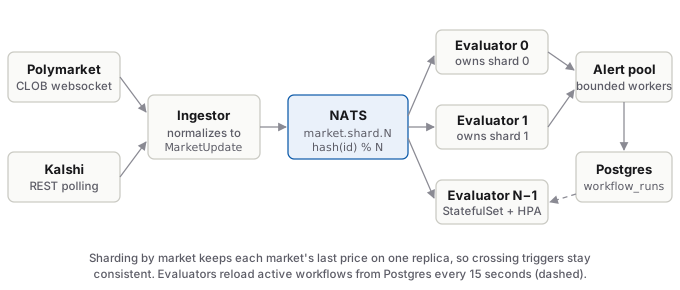
- Ingestion. One small, unsharded service holds the exchange connections and normalizes both feeds into a common
MarketUpdate. Exchange connections aren’t the bottleneck, so this stays simple. - The bus. Each update is published to NATS on
market.shard.N, whereN = hash(MarketID) % NUM_SHARDS. - Evaluation. Each evaluator replica subscribes to exactly one shard, reloads active workflows from Postgres every 15 seconds, and matches incoming updates against them.
- Actions. Matches go to a bounded worker pool with panic recovery, which runs the alert and writes a
workflow_runsaudit row. - Product. A Go API serves workflow CRUD and execution history, and a Next.js front end gives a low-code workflow builder.
The hard parts
Normalizing two very different feeds
A websocket stream and a REST poller produce different shapes on different schedules. Everything downstream depends on them looking the same, so normalization happens once, at the edge, into MarketUpdate. The evaluator never knows which exchange an update came from.
Scaling out without losing per-market state
price_crosses needs the last price seen for a market. If updates for one market could land on any replica, that state would be split and crossings would be missed or double-fired. Sharding by MarketID hash means a given market always lands on the same evaluator, so its lastByMarket state lives in one place.
To make shard ownership stable, evaluators run as a Kubernetes StatefulSet and parse their shard index from the pod ordinal in $HOSTNAME. The HPA is capped at NUM_SHARDS replicas, because a pod with an ordinal past that would have no shard to own.
Keeping the hot path observable
Every service exposes Prometheus metrics for queue depth, trigger-evaluation latency, websocket reconnects and publish counts. That’s how backlog is judged under load: queue depth should rise and fall, not grow without bound.
Results
The design target is 10K events/sec, and the load generator publishes synthetic MarketUpdates straight onto NATS at a configurable rate. Against a single-shard Docker Compose stack, it held ~2K events/sec with zero errors and queue depth returning to zero. The full 10K run against the eight-shard Kubernetes deployment, with the HPA scaled out, hasn’t been exercised yet: it needs a cluster to apply the manifests to.
What I’d do next
- Run the 10K events/sec load test on a real cluster with
NUM_SHARDS=8and record evaluation latency at the tail. - Add a
PortfolioUpdateaction. - Add trade execution last, behind an idempotency key, rate limiting and a dry-run flag, since it’s the action with the largest blast radius.